How Do You Know if Your Observation Is Greater Than the Mean in a Hypothesis Test

Learning Objectives
ane. Understand the conceptual deviation amongst a one sample, ii independent sample vs. paired tests.
2. Conduct and properly interpret a one sample test.
three. While you will not exist asked to calculate a two independent sample test statistic, you should be able to properly interpret a comparison of means test for two independent samples (sympathize/translate hypotheses, examination statistic and p-value). For an instance of the two sample Welch's test, click here.
4. Understand when to apply the Student's t or the z statistic in a comparison of ways test.
5. Calculate AND interpret a p-value.
General Steps in Conducting a Comparison of Means Exam
1. Make up one's mind blazon of comparison of means test.
(one sample, two sample, paired samples)
2. Make up one's mind whether a one- or ii-sided test.
iii. Examine the ceremoniousness of a comparison of means test (based on the assumptions)***.
4. Establish nothing and alternative hypotheses.
5. Decide whether a z-statistic or t-statistic is appropriate.
6. Calculate sample mean(south).
7. Calculate standard deviation of sample IF using a t-examination.
viii. Summate standard mistake.
9. Summate z-statistic or t-statistic.
10. Make up one's mind p-value from the exam statistic using the appropriate z or t distribution.
11. Interpret the p-value in terms of the hypotheses established prior to the test.
Blazon of Comparing of Means Examination
At that place are iii major types of comparison of means tests: (1) one sample test; (two) ii independent samples and (3) paired or repeated measures examination. It is of import to be able to differentiate between these iii tests. In each of the tests we make inferences to a population or populations based on ane or two samples.
One sample test : We make an inference to a population in comparing to some fix value. For case, we might exist involvement in knowing whether the dissolved oxygen levels in a lake meet a state standard of five mg/L.
Two independent sample test: In this test, we collect two independent samples to exam whether there is a difference in means between two populations (or if ane population mean is greater or less than the other) . Comparing GRE scores between men and women is an example of a two independent sample test.
Paired or Repeated measure test: This test compares paired information, such equally information collected before and after a treatment. Case: a comparison of NOx emissions from randomly selected automobiles earlier and subsequently an condiment is added to the fuel.
One-Sided vs. Two-Sided Comparison of Means Tests
For a comparison of means test, you may employ either a one-sided or 2-sided test. A one-sided test (leading to a one-sided p-value) examines whether i hateful is greater (or less than) the other hateful. If you lot want to test whether the hateful of population A is greater (or less) than the mean of population B, this is a ane-sided exam. If y'all want to test whether there is a difference between two means (without any directionality), and then you lot use a ii-sided examination (and subsequently a tw0-sided p-value (see below). The null and alternative hypotheses should reflect whether or not you are using a one- or ii-sided comparing of means test.
z-statvs. t-stat
A z-statistic should be calculated when the standard difference of the population(s) is known. If the standard divergence is not known, then the standard fault must be estimated using the standard deviation of the sample(south). Due to this interpretation, we must use the t-distribution which is thicker in the tails to business relationship for estimating the standard error with the sample standard deviation.
Test Statistic Calculation
In general terms, a comparing of means exam equals:

The standard error is the standard deviation of the sampling distribution of the sample hateful. In essence, the test statistic calculates how many standard errors the mean of the sample is abroad from the value that nosotros hypothesize. The one sample z-statistic is:
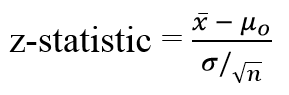
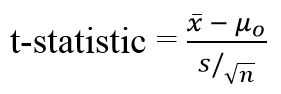
With the z-statistic, the standard error equals the standard divergence of the population (σ) divided past the square root of the sample size. With the t-statistic, the standard difference of the population is estimated with the standard divergence of the sample. With the t-statistic, nosotros assume that nosotros practice NOT know the standard deviation of the population (σ) and and so we estimate the standard error using the sample standard divergence. A student t table can be found at this Texas A & Thousand Statistics website.
p-values
A one-sided p-value is the probability that the test statistic is greater than (or less than) the calculated value. For a two-sided test, the ii-sided p-value is the probability that the test statistic is greater than OR less than the calculated value. It is VERY Important to know that the p-value is a provisional probability–a probability conditioned on the assumption that the NULL HYPOTHESIS is true. In the words of Moore, McCabe and Craig (2012, p. 365), a p-value is:
The probability, assuming Ho is true, that the test statistic would take a value as extreme or more farthermost than that really observed is called the p-value of a test. The smaller the p-value, the stronger the evidence against the H0 provided by the data.
Many statisticians consider a p-value less than 0.05 to exist statistically significant (and a p-value of <0.01 equally highly statistically significant). Equally a full general rule, the smaller the p-value, the stronger the evidence confronting the null hypothesis. If you determine a level of significance (α (alpha) level) prior to your test, this sets a 'type I' error rate. A blazon I error is the probability of rejecting the null hypothesis when it is in fact truthful. If the p-value is less than or equal to the a priori alpha level, we can state that at that place is statistical significance at the alpha level. To acquire more than about Type I errors, view this Khan University video.
Retrieve, however, that statistical significance is a unlike concept than 'practical' significance. Practical significance suggests that a divergence between two populations has 'real globe' significant. For instance, if nosotros have a very large sample size (e.chiliad., n=ane,000), we might be able to detect a very minor statistically pregnant difference of students' performance on a statistics exam based on gender (due east.g., 0.06%). While the estimated difference between boilerplate test scores of 0.06% may be statistically meaning (if we take a large north and modest standard deviations), a divergence of 0.06% betwixt male and female functioning on the exam may have no applied significant.
Assumptions of a One Sample Comparison of Ways Test
In order for our results of our comparison of means examination to be pregnant, we must make a few assumptions.
1. Population of concern is normally distributed.
2. Observations are independent (the value of one ascertainment is independent of the value of some other observation). When data are temporally or spatially correlated this supposition is violated.
Instance Problems
One Sample Hypothesis Test
(σ is known)
In 1979, the State of North Carolina adopted a chlorophyll a standard of xl ul/L for its rivers and lakes. Hashemite kingdom of jordan Lake (actually a reservoir) sits to the south of Chapel Hill, Due north Carolina and serves as a drinking water supply for much of the Triangle area. If you lot would like to learn more than about Jordan Lake nutrient management strategy, check out the NC Division of H2o Quality'due south link. We want to make up one's mind whether or not the chlorophyll a of the water of Jordan Lake is greater than the state standard (out of compliance). On the 4th of July! we become out and collect 100 randomly selected h2o quality samples from the reservoir (we typically wouldn't collect so many samples on one day, but for statistical simplification for this problem we will!). Based on our GIS map of Jordan Lake, we randomly sample points in the Jordan Lake polygon based on latitude and longitude values.
1. Because we are comparing a population (chlorophyll a in Jordan Lake) to a specific value forty ug/L, we utilize a one sample hypothesis test.
ii. Because we care whether or not the chlorophyll a concentration is greater than the land standard, we will use a one-sided test.
three. Examine the assumptions of the comparison of ways test. We will return to this at the end of this case.
4. A comparison of ways tests assesses/determines the evidence AGAINST the goose egg hypothesis (and in favor of the alternative). Because we want to determine whether or not the lake is meeting/exceeding the state standard, nosotros establish the following hypotheses:
Goose egg hypothesis (Ho)
Ho: μ ≤ 40 ug/L
-Retrieve that the hypotheses are about the POPULATION and therefore should contain population parameters and NOT sample statistics (such as xbar).
Culling hypothesis (Ha)
Ha: μ > xl ug/L
five. We will use the z-statistic because we are assuming we know the standard departure of the population (five.0 ug/Fifty). We will presume that nosotros know the population standard deviation of chlorophyll a, based on previous monitoring studies (5.0 ug/L). Because nosotros assume this value, we volition use the test based on the normal distribution (z-statistic).
half dozen. Nosotros summate the sample mean of the 100 chlorophyll a observations to be 41.0 ug/L.
vii. Because we are bold a KNOWN standard deviation of the population, we apply the z-statistic. The population standard deviation is given in the problem–we don't need to calculate it.
eight. To summate the z-statistic, nosotros commencement need to summate the standard error which equals southward/√northward = 5.0/√100 = 5/x = 0.50.
ix. Equally outlined above, the z-statistic equals the gauge minus the value of interest, all divided by the standard error. In this instance, our observed sample mean is 41.0. Nosotros calculate the z every bit (41.0 – xl)/0.50 which equals 1/0.fifty=2.
x. We now look up the value of 4 in the z-table to determine the p-value [p(z>2.0)]. In this instance, the p-value is equal to the area to the right of the z-stat of 2. Using this z-table, we look up a z-stat of 2. Considering we are interested in the probability to the right of the z-statistic of 2, we demand to decrease 0.9772 from one. Nosotros summate a one-sided p-value of 0.0228.
11. Interpret the p-value. We calculated a p-value of 0.0228 above. A p-value is a conditional probability: Assuming that the aught hypothesis is true, the p-value is the probability of getting a examination statistic as extreme, or more extreme, than we got [p(z>2.0)=0.0228]. A minor p-value provides stronger bear witness Against the nothing hypothesis. In this problem, we conclude that the data suggest that the mean chlorophyll a level (on July 4th) in Hashemite kingdom of jordan Lake is greater than the land standard of 40 ug/L.
12. In order for these results to be valid, we presume that chlorophyll a in Jordan Lake are normally distributed. We also presume contained sampling. The latter may non concord, if the observations are spatially correlated (if nearby observations are correlated with each other–spatial autocorrelation).
Comparison of Ways PPT
Sample Problems
1. True or Imitation: A p-value is the probability that the null hypothesis is true.
2. True or False: A very small p-value (p<0.01) provides bear witness in back up of the zippo hypothesis.
iii. True or False: All else constant, in a one sample test, the greater the sample size, the greater the positive test statistic or the smaller (more negative) the negative test statistic.
4. We want to examine the effectiveness of an ecology pedagogy seminar. We randomly select 50 seminar attendees and give them a test on environmental topics both earlier and after the seminar. We want to make up one's mind if the environmental education seminar improved environmental agreement. Which of the post-obit is the most appropriate test?
a. a paired, two-sided test
b. a two independent sample, 1-sided test
c. a paired, one-sided exam
five. We desire to determine whether a certain brand and model of automobile has a greater fuel efficiency in miles per gallon (mpg) than 50mpg. We randomly sample 100 cars of the aforementioned make and model. The hateful mpg of the sample is 53 mpg and the sample standard deviation is 5 mpg.
a. Establish the cypher and alternative hypotheses.
b. Calculate the appropriate test statistic.
c. True or Simulated: We should calculate a z-statistic.
d. Calculate the p-value and compare to an blastoff level of 0.05 to draw your conclusions.
vi. Nosotros sample two forests of loblolly pine copse (n=100 in each forest) and measure out their bore at breast meridian (dbh) in centimeters. We found the following hypotheses:
Ho: The mean DBH measurement of loblolly copse in forest A is less than or equal to the hateful in woods B.
Ha: The hateful of DBH measurement of loblolly trees in wood A is greater than the mean in forest B.
We utilize the post-obit test statistic (Welch'southward t-test) equation and get a t-statistic of -three.6.
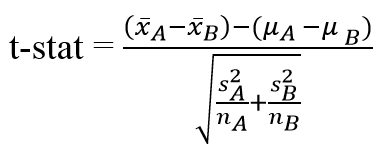
Truthful or Simulated: This exam statistic provides strong show against the nada hypothesis.
Solutions
This page was developed byElizabeth A. Albright, PhD of the Nicholas Schoolhouse of the Surroundings, Duke University.
Return to the Statistics Review home page.
Source: https://sites.nicholas.duke.edu/statsreview/means/
0 Response to "How Do You Know if Your Observation Is Greater Than the Mean in a Hypothesis Test"
Enregistrer un commentaire