Family of Straight Lines Passing Through a Point

In geometry, a pencil is a family of geometric objects with a common holding, for example the prepare of lines that pass through a given point in a plane, or the fix of circles that pass through ii given points in a plane.
Although the definition of a pencil is rather vague, the common characteristic is that the pencil is completely determined by any two of its members. Analogously, a set of geometric objects that are adamant by whatsoever three of its members is called a package.[1] Thus, the set of all lines through a signal in three-space is a packet of lines, any two of which determine a pencil of lines. To emphasize the two dimensional nature of such a pencil, information technology is sometimes referred to every bit a apartment pencil.[2]
Whatever geometric object tin can exist used in a pencil. The common ones are lines, planes, circles, conics, spheres, and general curves. Fifty-fifty points tin be used. A pencil of points is the set of all points on a given line.[1] A more mutual term for this prepare is a range of points.
Pencil of lines [edit]
In a plane, let u and v be ii distinct intersecting lines. For concreteness, suppose that u has the equation, aX + by + c = 0 and 5 has the equation a'X + b'Y + c′ = 0. Then
-
- λu + μfive = 0,
represents, for suitable scalars λ and μ, whatsoever line passing through the intersection of u = 0 and 5 = 0. This set of lines passing through a mutual indicate is called a pencil of lines.[three] The common indicate of a pencil of lines is chosen the vertex of the pencil.
In an affine plane with the reflexive variant of parallelism, a prepare of parallel lines forms an equivalence course called a pencil of parallel lines.[4] This terminology is consistent with the above definition since in the unique projective extension of the affine airplane to a projective plane a unmarried bespeak (bespeak at infinity) is added to each line in the pencil of parallel lines, thus making information technology a pencil in the above sense in the projective airplane.
Pencil of planes [edit]
A pencil of planes, is the set of planes through a given straight line in three-space, chosen the axis of the pencil. The pencil is sometimes referred to as a centric-pencil [5] or fan of planes or a sheaf of planes.[6] For example, the meridians of the globe are defined by the pencil of planes on the axis of Earth's rotation.
Two intersecting planes meet in a line in three-infinite, and so, determine the axis and hence all of the planes in the pencil.
In higher dimensional spaces, a pencil of hyperplanes consists of all the hyperplanes that contain a subspace of codimension 2. Such a pencil is determined by any two of its members.
Pencil of circles [edit]
Any two circles in the plane have a common radical centrality, which is the line consisting of all the points that accept the same ability with respect to the 2 circles. A pencil of circles (or coaxial system) is the set up of all circles in the airplane with the aforementioned radical axis.[7] To be inclusive, concentric circles are said to have the line at infinity as a radical axis.
There are five types of pencils of circles,[8] the two families of Apollonian circles in the analogy above stand for ii of them. Each type is adamant by two circles called the generators of the pencil. When described algebraically, it is possible that the equations may admit imaginary solutions. The types are:
- An elliptic pencil (crimson family of circles in the figure) is divers by ii generators that pass through each other in exactly two points. Every circle of an elliptic pencil passes through the same two points. An elliptic pencil does not include any imaginary circles.
- A hyperbolic pencil (blue family of circles in the figure) is defined by two generators that do non intersect each other at whatever point. It includes real circles, imaginary circles, and two degenerate point circles called the Poncelet points of the pencil. Each bespeak in the plane belongs to exactly one circumvolve of the pencil.
- A parabolic pencil (equally a limiting instance) is defined where two generating circles are tangent to each other at a single point. Information technology consists of a family of real circles, all tangent to each other at a unmarried common signal. The degenerate circumvolve with radius zero at that point besides belongs to the pencil.
- A family of concentric circles centered at a common center (may be considered a special case of a hyperbolic pencil where the other indicate is the betoken at infinity).
- The family unit of straight lines through a mutual betoken; these should be interpreted as circles that all pass through the point at infinity (may be considered a special case of an elliptic pencil).[9] [10]
Backdrop [edit]
A circle that is orthogonal to ii fixed circles is orthogonal to every circumvolve in the pencil they determine.[11]
The circles orthogonal to 2 fixed circles course a pencil of circles.[11]
Ii circles determine 2 pencils, the unique pencil that contains them and the pencil of circles orthogonal to them. The radical axis of one pencil consists of the centers of the circles of the other pencil. If ane pencil is of elliptic type, the other is of hyperbolic type and vice versa.[11]
The radical centrality of whatsoever pencil of circles, interpreted as an space-radius circumvolve, belongs to the pencil. Any three circles belong to a common pencil whenever all 3 pairs share the same radical axis and their centers are collinear.
Projective space of circles [edit]
There is a natural correspondence between circles in the plane and points in three-dimensional projective space; a line in this infinite corresponds to a one-dimensional continuous family of circles, hence a pencil of points in this infinite is a pencil of circles in the aeroplane.
Specifically, the equation of a circle of radius r centered at a betoken ( p,q ),

may be rewritten as

where α = 1, β =p, γ =q, and δ =p 2 +q 2 −r 2 . In this course, multiplying the quadruple (α,β,γ,δ) by a scalar produces a different quadruple that represents the aforementioned circumvolve; thus, these quadruples may exist considered to be homogeneous coordinates for the space of circles.[12] Straight lines may as well be represented with an equation of this type in which α = 0 and should exist thought of as being a degenerate form of a circumvolve. When α ≠ 0, nosotros may solve for p = β/α, q = γ/α, and r =√(p ii +q two − δ/α); the latter formula may give r = 0 (in which instance the circumvolve degenerates to a point) or r equal to an imaginary number (in which case the quadruple (α,β,γ,δ) is said to represent an imaginary circle).
The set of affine combinations of two circles (α1,β1,γ1,δ1 ), (α2,β2,γ2,δ2 ), that is, the set of circles represented by the quadruple

for some value of the parameter z , forms a pencil; the 2 circles beingness the generators of the pencil.
Cardioid as envelope of a pencil of circles [edit]
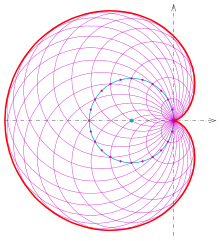
cardioid as envelope of a pencil of circles
Another blazon of pencil of circles tin can be obtained every bit follows. Consider a given circle (called the generator circle) and a distinguished point P on the generator circle. The prepare of all circles that pass through P and take their centers on the generator circumvolve grade a pencil of circles. The envelope of this pencil is a cardioid.
Pencil of spheres [edit]
A sphere is uniquely determined by four points that are non coplanar. More generally, a sphere is uniquely determined by iv conditions such as passing through a point, beingness tangent to a plane, etc.[13] This property is coordinating to the property that iii non-collinear points determine a unique circumvolve in a plane.
Consequently, a sphere is uniquely adamant past (that is, passes through) a circumvolve and a indicate not in the plane of that circle.
By examining the common solutions of the equations of two spheres, it tin be seen that two spheres intersect in a circle and the airplane containing that circle is called the radical plane of the intersecting spheres.[14] Although the radical plane is a real aeroplane, the circumvolve may exist imaginary (the spheres have no real indicate in common) or consist of a single bespeak (the spheres are tangent at that point).[15]
If f(x, y, z) = 0 and g(x, y, z) = 0 are the equations of two singled-out spheres and so

is likewise the equation of a sphere for arbitrary values of the parameters λ and μ. The set of all spheres satisfying this equation is called a pencil of spheres determined by the original two spheres. In this definition a sphere is allowed to be a airplane (infinite radius, center at infinity) and if both the original spheres are planes then all the spheres of the pencil are planes, otherwise there is just one plane (the radical plane) in the pencil.[16]
If the pencil of spheres does not consist of all planes, then there are 3 types of pencils:[15]
- If the spheres intersect in a real circle C, then the pencil consists of all the spheres containing C, including the radical plane. The centers of all the ordinary spheres in the pencil prevarication on a line passing through the center of C and perpendicular to the radical airplane.
- If the spheres intersect in an imaginary circle, all the spheres of the pencil likewise pass through this imaginary circle but equally ordinary spheres they are disjoint (have no existent points in mutual). The line of centers is perpendicular to the radical airplane, which is a existent aeroplane in the pencil containing the imaginary circle.
- If the spheres intersect in a point A, all the spheres in the pencil are tangent at A and the radical airplane is the common tangent plane of all these spheres. The line of centers is perpendicular to the radical plane at A.
All the tangent lines from a fixed point of the radical plane to the spheres of a pencil have the aforementioned length.[15]
The radical plane is the locus of the centers of all the spheres that are orthogonal to all the spheres in a pencil. Moreover, a sphere orthogonal to whatever two spheres of a pencil of spheres is orthogonal to all of them and its center lies in the radical plane of the pencil.[15]
Pencil of conics [edit]
A (not-degenerate) conic is completely determined by 5 points in general position (no three collinear) in a plane and the system of conics which pass through a fixed set of iv points (again in a airplane and no three collinear) is called a pencil of conics.[17] The 4 common points are called the base points of the pencil. Through any betoken other than a base betoken, there passes a single conic of the pencil. This concept generalizes a pencil of circles.
In a projective aeroplane defined over an algebraically closed field whatsoever ii conics meet in four points (counted with multiplicity) and so, make up one's mind the pencil of conics based on these four points. Furthermore, the four base points determine three line pairs (degenerate conics through the base of operations points, each line of the pair containing exactly two base points) and and then each pencil of conics will contain at most iii degenerate conics.[18]
A pencil of conics can exist represented algebraically in the following way. Let C 1 and C 2 be two distinct conics in a projective aeroplane defined over an algebraically closed field K . For every pair λ, μ of elements of K , non both cipher, the expression:

represents a conic in the pencil determined past C 1 and C two . This symbolic representation can exist made concrete with a slight abuse of notation (using the aforementioned annotation to denote the object every bit well every bit the equation defining the object.) Thinking of C 1 , say, as a ternary quadratic form, and so C ane = 0 is the equation of the "conic C ane ". Another concrete realization would be obtained by thinking of C ane as the 3×3 symmetric matrix which represents it. If C 1 and C 2 have such concrete realizations so every fellow member of the above pencil will every bit well. Since the setting uses homogeneous coordinates in a projective aeroplane, 2 concrete representations (either equations or matrices) give the same conic if they differ by a non-goose egg multiplicative constant.
Pencil of plane curves [edit]
More generally, a pencil is the special case of a linear arrangement of divisors in which the parameter space is a projective line. Typical pencils of curves in the projective plane, for instance, are written as
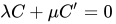
where C = 0, C′ = 0 are plane curves.
History [edit]
Desargues is credited with inventing the term "pencil of lines" (ordonnance de lignes).[19]
An early writer of modern projective geometry Yard. B. Halsted introduced many terms, virtually of which are now considered to be primitive.[ according to whom? ] For instance, "Straights with the same cross are copunctal." Likewise "The aggregate of all coplanar, copunctal straights is called a flat-pencil" and "A piece of a flat-pencil bounded by 2 of the straights as sides, is chosen an angle."[twenty]
See also [edit]
- Package aligning
- Lefschetz pencil
- Matrix pencil
- Pencil beam
- Fibration
- Locus
Notes [edit]
- ^ a b Immature 1971, p. 40
- ^ Halsted 1906, p. ix
- ^ Pedoe 1988, p. 106
- ^ Artin 1957, p. 53
- ^ Halsted 1906, p. 9
- ^ Wood 1961, p. 12
- ^ Johnson 2007, p. 34
- ^ Some authors combine types and reduce the list to three. Schwerdtfeger (1979, pp. viii–10)
- ^ Johnson 2007, p. 36
- ^ Schwerdtfeger 1979, pp. 8–10
- ^ a b c Johnson 2007, p. 37
- ^ Pfeifer & Van Hook 1993.
- ^ Albert 2016, p. 55.
- ^ Albert 2016, p. 57.
- ^ a b c d Woods 1961, p. 267.
- ^ Woods 1961, p. 266
- ^ Faulkner 1952, pg. 64.
- ^ Samuel 1988, pg. 50.
- ^ Primeval Known Uses of Some Words of Mathematics , retrieved July fourteen, 2020
- ^ Halsted 1906, p. 9
References [edit]
- Albert, Abraham Adrian (2016) [1949], Solid Analytic Geometry, Dover, ISBN978-0-486-81026-three
- Artin, E. (1957), Geometric Algebra, Interscience Publishers
- Faulkner, T. E. (1952), Projective Geometry (2nd ed.), Edinburgh: Oliver and Boyd, ISBN9780486154893
- Halsted, George Bruce (1906). Synthetic Projective Geometry. New York Wiley.
- Johnson, Roger A. (2007) [1929], Avant-garde Euclidean Geometry, Dover, ISBN978-0-486-46237-0
- Pedoe, Dan (1988) [1970], Geometry /A Comprehensive Course, Dover, ISBN0-486-65812-0
- Pfeifer, Richard E.; Van Claw, Cathleen (1993), "Circles, Vectors, and Linear Algebra", Mathematics Magazine, 66 (2): 75–86, doi:x.2307/2691113, JSTOR 2691113
- Samuel, Pierre (1988), Projective Geometry , Undergraduate Texts in Mathematics (Readings in Mathematics), New York: Springer-Verlag, ISBN0-387-96752-iv
- Schwerdtfeger, Hans (1979) [1962], Geometry of Complex Numbers: Circle Geometry, Moebius Transformation, Non-Euclidean Geometry, Dover, pp. 8–10 .
- Young, John Wesley (1971) [1930], Projective Geometry, Carus Monograph #4, Mathematical Association of America
- Woods, Frederick S. (1961) [1922], Higher Geometry / An introduction to advanced methods in analytic geometry, Dover
External links [edit]
- Weisstein, Eric W. "Pencil". MathWorld.
Source: https://en.wikipedia.org/wiki/Pencil_(geometry)
0 Response to "Family of Straight Lines Passing Through a Point"
Enregistrer un commentaire